Re-Architecting a Regulated
Switching Journey for Mobile
Transforming a dense desktop CASS flow into a cognitively lighter, mobile-first interaction architecture
without changing regulatory structure.
Project Overview
Role: Product Designer
Timeline: In development (launch pending)
Tools: Figma, Miro
Team Setup: Product Manager, BA, Engineering, Design System (NEL), Content
Strategic Framing - Designing for Reuse, Compliance & Scale

Before design began, stakeholders raised foundational questions:
-
How can this journey be reusable across Internet Banking and Mobile?
-
How can we leverage existing CASS APIs?
-
Where should switch initiation live in the app?
-
How should unhappy paths be surfaced?
-
How do we ensure accessibility compliance?
This reframed the project from a mobile migration to a cross-channel architecture initiative.
My role was to translate these platform-level concerns into a scalable interaction system.
Existing System Analysis - Understanding the Structural Baseline
The Internet Banking CASS journey consisted of 4–5 steps.
However, each step clustered multiple unrelated inputs on a single page.
Challenges identified:
-
High information density
-
Mixed categories within single screens
-
Cognitive overload
-
Limited mobile adaptability
-
Implicit differentiation between Full vs Partial switch
While compliant, the structure was not optimized for mobile interaction patterns.

Behavioral & Process Insight - Mapping Emotional and Operational Friction

We reviewed:
-
As-Is Journey Mapping (Bangalore workshop)
-
Empathy mapping artifacts
-
User story & persona created using the IBM ICA tool to accelerate discussion
Key insight:
Switching accounts carries emotional weight — users seek clarity, reassurance, and control.
This validated the need for:
-
Explicit switch-type differentiation
-
Clear sequencing
-
Strong confirmation states
-
Reduced cognitive stacking

Market & Pattern Benchmarking - Understanding Switching Design Patterns

A competitor review helped identify:
-
Step structuring approaches
-
How reassurance is surfaced
-
How progress indicators are handled
-
Error-state communication strategies
This informed decisions around sequencing and clarity without overcomplicating the regulated structure.

Interaction Architecture Redesign
From Dense Pages to Single-Intent Screens
Instead of compressing steps, the mobile strategy decomposed them.
Internet Banking:
-
Fewer steps
-
More information per screen
Mobile:
-
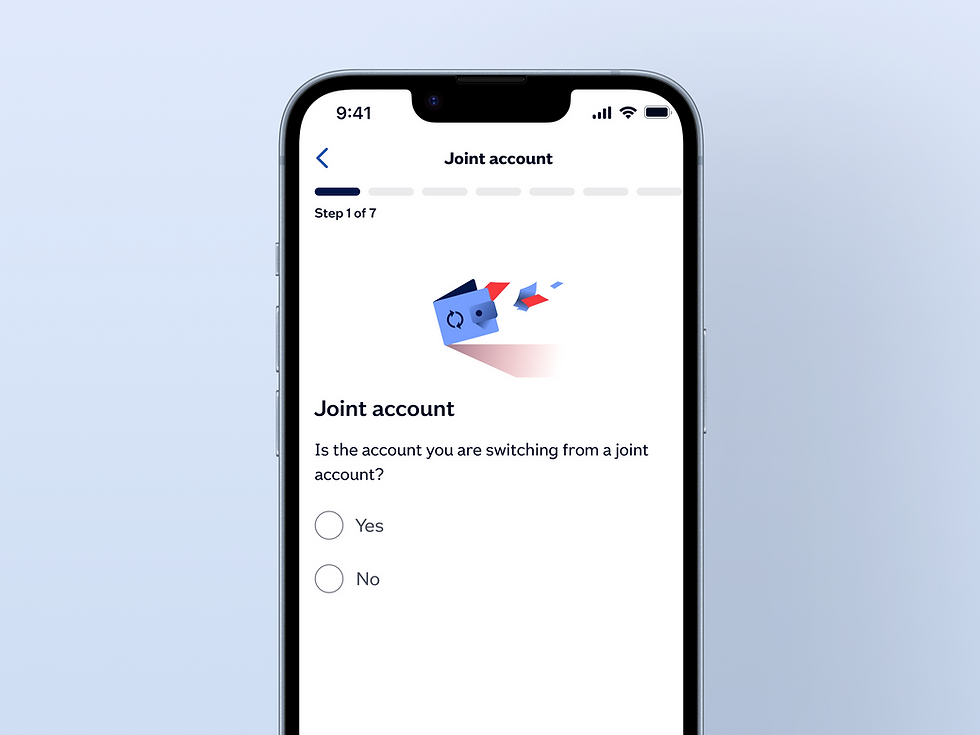
One primary question per screen
-
Logical sequencing
-
Progressive disclosure
-
Clear branching between Full and Partial switch
This reduced cognitive load while maintaining backend compatibility.

Wayfinding Without Breaking Compliance
A key debate centered around the progress indicator.
Options considered:
-
Dynamic step adaptation based on branch logic
-
Retaining fixed regulatory structure
Final decision:
-
Maintain regulatory step structure
-
Simplify sequencing clarity
-
Reduce visual noise
This balanced usability improvements with system constraints.


Structuring Unhappy Paths
We explored how failed or incomplete switches should be surfaced.
Considerations included:
-
Clear status communication
-
Error state messaging
-
Recovery pathways
-
Maintaining user trust even during rejection
Failure handling was designed as part of the system — not an afterthought.


Feature Spotlight: Digital Cheque Deposit (POC)
Goal: Enable users to deposit cheques digitally via the mobile app
UI/UX Considerations:
-
Simple step-by-step capture process
-
Clear confirmation and receipt post-deposit
-
Help icons and microcopy to guide users unfamiliar with digital cheque deposits
-
Mobile camera permissions and image quality indicators for clarity
Stakeholder Feedback:
-
The feature was well received internally and appreciated for its potential to reduce reliance on branch visits and manual processing.
[Placeholder for visuals: Wireframes and final screens of cheque deposit flow]




